Key Preparation Technology for Hard Carbon-Based Composited Anode and Its Application in Sodium-ion Battery
Aim and Objective
This project aims to address the issues of limited capacity and high temperature in conventional hard carbon material preparation via inverse materials design and its experimental realization. Specifically, the goal is to develop a low-temperature macro-preparation technology for hard carbon, optimize its design, and create a new flame-retardant electrolyte for Na-ion batteries.
This will lead to a high-performance hard carbon-based sodium-ion battery system, contributing to sustainable large-scale energy storage solutions. The project combines the expertise of Polish and Chinese researchers to optimize hard carbon-based microstructure, study the intrinsic relationship between thermodynamic behavior and safety performance, and develop a low-cost, high-performance hard carbon anode material and soft pack sodium-ion battery.
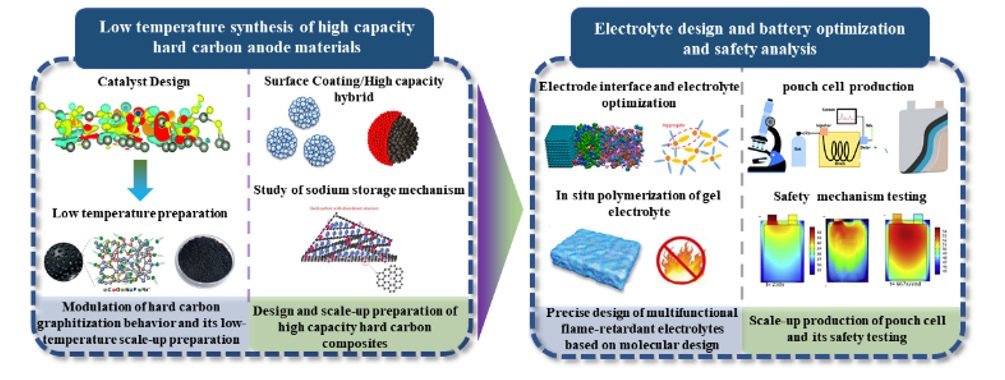
Specific Objectives
Principal Investigators

Dr. Oleksandr I. Malyi
So far, he has published more than 105 scientific articles in solid-state physics, including Chem. Rev., Mat. Today, Matter, App. Phys. Rev., Phys. Rev. Lett., Sci. Adv., Adv. Mater., Angew. Chem., Adv. Energy Mater., Small, etc., cited over 4600 times, H-index=36.
Prof. Yuxin Tang
So far, he has published more than 110 scientific articles in the field of materials chemistry, including Sci. Adv., JACS, EES, Nat. Commun., Adv. Mater., Angew. Chem., Chem. Soc. Rev., Adv. Energy Mater., Adv. Funct. Mater., Small, etc., cited over 10000 times, H index=55, authorized 1 US patent and 1 Singapore patent, 5 US patent applications (including 3 patent assignments).
Project Publications
Publications and manuscripts from the Inverse Materials Design group supported by the KEYTECH project.
Published papers
- Mechanism-Guided Inverse Electrolyte Design for Advanced Metal-Ion Batteries
Advanced Functional Materials, 2026
- Interchain bottlenecks and helical-channel pathways as the origin of low Li⁺ conductivity in crystalline PEO
Physical Chemistry Chemical Physics, 2026
- Rational design principles for Na- and Li-ion carbon anodes from interlayer spacing control
PRX Energy, 2026, 5, 023010
- Lattice reconstruction strategy for fast-charging plateau-type hard carbon anodes in ultra-long-life sodium-ion batteries
Energy & Environmental Science, 2026, 19, 3640–3652
- Lewis-acid fluorides: unlocking high-performance solid-state polymer electrolytes
Science China Materials, 2026, 69, 2704–2709
- Breaking diffusion limit in ester-flame-proof Na-ion electrolytes through solvent coordination chemistry
Angewandte Chemie International Edition, 2025, 64, e202512950
- Pushing slope- to plateau-type behavior in hard carbon for sodium-ion batteries via local structure rearrangement
Energy & Environmental Science, 2025, 18, 4312–4323
Accepted manuscripts
- Transferability of foundation MACE models to amorphous chemistry: where they work and where they fail
Journal of Non-Crystalline Solids, accepted (*corresponding author)
Submitted manuscripts
- Density-dependent structural role of oxygen in disordered carbon revealed by machine-learned molecular dynamics
Journal of Physical Chemistry Letters, submitted; in appeal (*corresponding author)
- Anion-Regulated Ionic Liquid Gel Electrolyte with Enhanced Li⁺ Transport for High-Performance Lithium Metal Batteries
Science China Materials, submitted (*corresponding authors)
Research software
IMDgroup-gorun — VASP and ATAT job-submission workflows for Slurm.
Conferences
- I. Radchenko, Role of crystalline domains of hard carbon in Li/Na storage, Empa, Switzerland, Aug. 29, 2025, invited talk.
- I. Radchenko, O. Malyi “Role of crystalline domains of hard carbon in Li/Na storage”, Psi-k 2025, 25-28 Aug. 2025. Ecublens, Switzerland. Poster presentation.
Project Overview